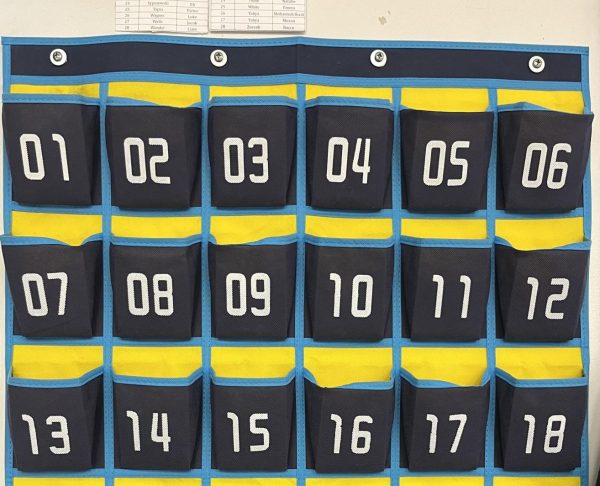
This school year, similar to last year, has had the district cracking down on the use of cell phones as well as implementing restrictions. We have been introduced to cell phone pockets or folders where students must keep their phones until the end of class. Although it’s nothing new procedure-wise, the school seems to be stricter with limitations as perceived in various classrooms. Overall, it seems like the results so far are positive.
Principal Richter presents his thoughts on the procedures so far. He says, “Overall, I think it is going really well. The most important aspect of any new policy is consistent implementation in all areas.” It is clear that Richter puts an emphasis on consistency and its correlation to effectiveness. Meaning, teachers should be implementing the no-phone policy daily. As for myself, in each and every one of my classes, although some more than others, I have observed daily practice of the rule. Each and every period, as the bell rings students are instructed to bring their phones up to their pockets. Additionally, Richter also states that another reason behind the policy’s success was his honest and up-front attitude towards parents and students regarding the policy at the beginning of the school year. He says, “I think being clear up front in the school year with students and families was also helpful to it being successful.”
Furthermore, teachers have ideas contributing to cell phones this year based on observations in their own classrooms. Mr. Biernacki says that he thinks it is important to have restrictions on phone use during class because it helps students focus. This is something that he observes in class each day. When asking him his opinions on the effectiveness of the policy, Biernacki says, “It is a very good start, I think that we can continue to evolve in how we execute it.” In addition, he provides insight on his priorities regarding cell phones. He says that he does not want to be fixated on phones while teaching because it will not let him perform to the best of his ability. So, having phone holders in class seems to help teachers direct their attention to important things like the education of their students, without needing to worry about the distraction of phones. On the other hand, Biernacki also thinks that it could be easier on everyone altogether if phones were away completely. He states, “It would be easier to just have them be away which logistically would be difficult to do, but a cool place to get too.”
As well as Mr. Biernacki, Ms.Charles also adheres and contributes to the enforcement of cell phone restrictions. She says, “Regarding the no-phones policy, I think it’s a really positive change not to be distracted by our phones, teachers included. I get it, I have the same instinct to look at my phone just like students do, but now that we are all focused together, we are getting a lot more learning done in class.” Again, it is clear that teachers are very focused on keeping these policies alive to help the learning of students but also to keep themselves in check as well.
Cell phone restrictions are being heavily enforced throughout the school as seen by our principal as well as teachers in their very own classrooms. Students throughout the school have been able to observe these implementations daily and according to teachers, it has helped the learning in their classroom.